Johann Georg Elser (4 January 1903 – 9 April 1945)

Filed under: shoa — Eike @ November 8, 2009 10:10 pm

“”This was the noblest Roman of them all.
All the conspirators, save only he,
Did that they did in envy of Caesar;
He only, in a general honest thought
And common good to all, made one of them.
His life was gentle, and the elements
So mixd in him that Nature might stand up
And say to all the world, This was a man!”

70 years ago, on 8 November 1939 Georg Elsers assassination attempt on the life of Adolf Hitler failed. Undoubtly had he succeeded he would not be rememberes as a hero [1] but as a madman who killed a great german statesman – after all, the biggest crimes of Hitler and Nazi Germany where still to come. Had Hitler been killed in 1939 history would have, I’m afraid, looked quite favourably upon him.

Unlike the conspirators of the 20 July plot Elser did not plan for a coup d’état or to take power himself; Elser, who acted all alone, had no illusions that Hitlers assassination could stop the Nazis. He had hoped that after the death of  the top Nazis more moderate elements would rise to the head of the Nazi party.

More than 60 years after his death Elser was finally recognized – in a ceremony during which a small Else memorial was unveiled – as somebody who ‘did not simply look away” during the “Third Reich”.

  1. Not that he was remembered as a hero in any case; for most of the time Germany preferred to think of him as a mere criminal and some suggested that he was in fact a Nazi himself

Was Hitler democratically elected?

Filed under: Science, shoa — Eike @ February 19, 2009 3:10 pm

In the comment section of a post in the Pharyngula science blog[1] I found an entry where a man rather emphatically stated “If you think that Hitler was democratically elected you should buy a good history book“. I do have a good history book (in fact, I have a lot of good history books), so I feel rather comfortable when I say that, yes, Hitler had been elected democratically.

People who say that Hitler wasn’t really elected are usually germanophiles who search for excuses for crimes of the german people in the “Third Reich” (the argument is that a small undemocratic minority oppressed the good people of germany). But since Pharyngula is an american blog the case here might be a lot less sinister. The idea that Hitler wasn’t elected democratically is probably an allusion to the fact that he[2] never got more than 50% of the votes (th e best result was some 44%). Americans, with their “the winner takes it all”-system tend to forget that you can win a german election without winning a majority.

The problem with this is that, without a majority, you have to form either a coalition with other parties, or  form a minority goverment, or both, and in fact that was the problem that had plagued the Republic from the beginning. To put the results into perspective, the 43,9% for the NSDAP in the 1933 election was the best result any party had ever had in the Republic of Weimar from 1919 to 1933[3] (second best was 37,8% for the Social Democrats immediately after WWI)[4]. Governments were habitually formed without any democratic basis at all, so the result of the 1933 election might have looked like a step forward.

It turned out that there is yet another way to govern without a majority – in March 1933 the german parliament passed what is known as „Ermächtigungsgesetz“ (Gesetz zur Behebung der Not von Volk und Reich), a law that allowed the Nazi/Deutschnationale Coalition to govern without the consent of the parliament. That this was in fact an unconstitutional law is a mere technicality – it was passed with a vast majority that would have allowed to change the constitution in any case, so the parliament skipped a step[5].

So,since Hitler and the NSDAP had more votes than any other party during the Republic of Weimar and governed on the basis of a law that had been passed by the absolute majority of the parliament is seems reasonable to conclude that he was indeed democratically elected.

The more important point is that this question is not as such relevant. I’m not sure you can blame the german people for electing or not electing Hitler [6] – after all he didn’t went into the election with the promise of perpetrating a holocaust, and his programme was not much more radical or antisemitic than that of some other parties. The pretty much collective crime of the german people[7] was that they supported Hitler and his party even after they had started comitting unspeakable crimes and that a sizable fraction of the population supported him in comitting those crimes.The difficult thing about democracy is that majorities (pluralities)[8] are sometimes wrong and that you have to decide if and when it is your moral duty to follow the wrong decisions many, or when to fight them.


[1] Dang, I can’t seem to find the post I’m refering to – no wonder, Prof. Myers writes more blog posts per month than I do in a year. In the post he was (again) adressing the silly contention that Darwinism inevitably results in genocide (actually it doesn’t).

[2] As a technicality “Hitler” wasn’t elected at all – the Republic of Weimar had a system of proportional representation where citizens elected parties, not persons. In practial terms the NSDAP was in some conservative parts of the electorate probably more a liabilty than an asset to Hitler. The german head of state Hindenburg appointed Hitler Chancellor only after he was reassured that the actual affairs of government would be run by the conservative Deutschnationale (German National) Party.

[3] Sautter, Udo „Deutsche Geschichte seit 1815: Daten, Fakten, Dokumente“ Tübingen 2004, p.166f

[4] Incidentally, counted in percentages the NSDAP had a better democratic legitimation than any party in the Federal Republic of Germany for at last 20 years – the best result in this time was 44,3% for the conservative „Union“ in the 1987 election and as the name suggests even this is a (permanent) coalition of two parties (CDU/CSU). For comparison, the elecorate in the Republic of Weimar was about 45 million voters, in the FRG it’s about 60 million.

[5] To the members of the Weimar parliament such a law looked propably less portentous than to a modern-day democrat; after all there had been already two previous „Ermächtigungsgesetze“ during the term of Friedrich Ebert .

[6] If anything it is strange that people elected a person who had already served a term for high treason.

[7] Yes, I know that phrase won’t make me any friends.

[8] The distinction between a majority and a plurality is much harder to make in german

    Sometimes you can forget about the “other site”

    Filed under: shoa — Eike @ November 2, 2008 9:15 pm

    Following the recent relaunch of shoa.de I got a complaint via e-mail; it stated that, since the site does not feature any articles that “doubt the holocaust” we fail to provide “the other side of the argument” and thus are a biased (and therefore, it was implied, an unreliable) source.

    There are indeed multiple sides to many issues regarding the holocaust. For example there is a debate between the “intentionalists”, who say that the Nazis planned to exterminate the jews from the beginning (especially since the Nazis used words like “extermination” from the very start) and “functionalists” who say that the annihilation of the european jews was the culmination of process that evolved as the “Third Reich” plodded along. What makes these interpretations legitimate  sides of a debates is that they are brought forth by reputable scholars who draw different conclusions from all of the available evidence.

    People who right out deny the holocaust do not. They ignore evidence that does not suit their purpose, distort it, or make up their own ‘evidence’. In this case the argument has still two sides, but one is the truth and the other is lies; to suggest that holocaust denial should be entitled to equal air  time means to suggest that it is just as important to spread lies as it is to tell the truth.

    To which I say, bollocks. I cannot stop anyone from lying, but as far as I have a say in this holocaust deniers will have to lie at their own expense. No law about free spech and no rule of fairness compels us to devote what little ressources we have to publish the lies we’ve set out to refute in the first place.

      Shoa.de – Another Relaunch Approaching

      Filed under: Joomla, Projects, self referential, shoa — Eike @ October 30, 2008 12:49 pm

      For some four years now I volunteer as a webmaster for shoa.de, one of the largest german Holocaust ressource sites. I moved it from the original static HTML pages to Mambo and through various Joomla Versions. When I was finally prepared to give on Joomla version 1.5 came along with the wonderful beez template, and I decided to give Joomla another go. Tomorrow will be the official relaunch on a new server, and with a new name, too. Shoa.de will still work (it is after all the name of the registered non-profit), but the main domain will be  the not particularly original zukunft-braucht-erinnerung.de.

      I had hoped to make a bit of an event from the relaunch, but as things are going (I’m terribly busy and paid work goes first) I’m glad that I made it at all, and there are a lot of things left to do – the old page used tables for image captions that now need to be removed, some things (like pagination) are not styled at all, we purchased a cache component that I have been unable to get to work so far etc.  But still the new site is already looking much better than the old one, and now we have at least a solid base from which we can work our way towards accessibility.

      So, why I am doing this?

      Building or re-building a large website is a lot of work, even if you’re part of a team (graphics design was done by Thorsten Kaiser,  content editing is done mainly by shoa.de founder Stefan Mannes and his company kakoii.de and several other volunteers).

      It is occasionally speculated in online forums (what is the plural of “forum” ?) that shoa.de is either heavily subsidized by the german federal government or that we are paid for by the Israel Mossad as part of a mission to make the innocent german people feel bad about themselves.

      As they say, if I’m part of a conspiracy then where is my share?

      In fact that shoa.de runs at all is mostly by courtesy of Thomas Kochler from the hosting company schuko.net, who donated the server and pays for our traffic. If you are looking for reliable and competent hosting in Germany you should consider him, it’s a tad more expensive than the big companies but you will get excellent service. Then there are fees from the members of the non profit (it think it’s 15 Euro per year and member), we got a little money when the portal won an award two years ago, and we get the occasional donation (though that’s usually not money – for example various publishing companies donated prices for a school contest we arranged). And even if there was money the charter of the non-profit forbids that we pay money to ourselves.

      So if it’s not for the money why am I, why are we doing this ? After all the holocaust happened a long long time ago, isn’t it time to move on, put the memories to a rest, bla bla bla.

      The answer is rather simple. Nazism, fascim, antisemitism in Germany are not things of the past. Quite on the contrary, in some areas at least they seem to be on the rise. The problem are not so much the violent fascist thugs, even if they routinely maim or kill foreigners or lefties. After all there are laws against assault and murder, and Germany has a police force that would be quite capable to enforce them. The problem is a form of public acceptance – it is widely believed that the political views of Nazism are understandable and justfied, and that just its’ methods are a little bit too extreme [1].

      Well, I’m not going to accept it [2]. That Nazis should be allowed to go on while the people who are against Nazis should stop is, to me, unthinkable.

      That’s why.

      1. And of course in the aftermath of the german unification most of the left suffered a case of sudden spinelessness and converted to views that had been previously held only by the extremist right - "the boat is full" (so no more immigration), "we must protect our industry against jewish reparation claims" etc. So there is no real counterweight to the right anymore.
      2. And why would I? That the left are the losers of history is not because there is something wrong with being against nazis, or longing for a better world. It's because traditionally lefties are, in their majority,  wimps who would betray their every conviction and their comrades for a slap on the back from the right (Social Democrats, I'm looking at you). I don't have to do this to myself.

      Where Have I been While My Peers Have Been Harrassed with the Holocaust?

      Filed under: shoa — Tags: , — Eike @ March 4, 2008 1:05 am

      Deborah Lipstadt has a blogpost on about different approaches to holocaust education. Among others she has a link to an article in the New York Times about “The Search”, a comic book about the holocaust that is going to be introduced in german classrooms. While I’m pretty much indifferent to the comic book idea (the thing was conceived by the Anne Frank Haus, so I’m at least convinced it will be high quality stuff) I was taken aback by what the NYT had to say about the topic of holocaust remembrance in german schools. They write

      Passing is the shock therapy, with its films of piled corpses, that earlier generations of schoolchildren had to endure.

      [...]

      Ask many Germans now in their 20s, 30s and 40s, and they will describe elementary and high school history classes that virtually cudgeled them into learning about Nazis and the Holocaust. The other morning Jutta Harms recalled her class in a small town in the north of West Germany during the late 1970s. Ms. Harms now works for Reprodukt, a leading Berlin publisher of graphic novels.

      “Students had to fight to talk freely about the war,” she recounted, “and, being confronted in class by the emotions of the teachers, there wasn’t any space to feel for ourselves.”

      I think the NYT fell victim to mystification. The idea that there is too much or too aggressive holocaust education in Germany is a rather recent (post-unification) trope, although many people obviously have updated their memory to match newspaper reports about their alleged acquired guilt complex.

      I’m in my late thirties, which puts me in the same age group as Jutta Harms. Elementary school for me started in 1977 in a small town in Baden-Württemberg; after that I visited a grammar school in the same town for four years before I switched schools and went to a boarding school close to the border of Württemberg and Bavaria. That we were made to feel guilty for the holocaust was not a common complaint among me and my fellow students, mainly because nobody tried to make us feel that way in the first place.

      Holocaust education was mainly a matter for three subjects in school: history, german and religious education (the last of which was supposed to teach you about ethics). I opted out of religious education when I was old enough (actually I had a brief stint in religion class after I switched schools before I could opt out again), so I can’t say much about that.

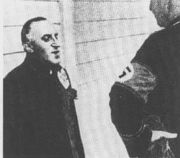
      As for my history lesson, movies of piled corpses didn’t figure prominently in there. There might have been the occasional blurry back and white picture of victims of extermination camps, but the history book mainly featured the much more harmless image of the imprisoned Carl von Ossietzky – menacing enough, but not traumatizing. As for the general prominence of the holocaust education, in my final exam I got a rather good grade for an essay about the german attack on the soviet union that didn’t even mention dead jews – I simply was unaware of the connection and described the events from a purely military point of view, which obviously got the approval of my teachers. It’s not that we didn’t learn a lot about the Nazi era, but that was by no means all holocaust education.

      The shoa was also a topic in our german lessons (actually, in the late 80s “shoah” was merely the title of a Claude Lanzmann movie as far as germans were concerned). We actually read a book about it, Damals war es Friedrich by Hans Peter Richter, a story about the friendship of a jewish and an “aryan” boy during the rise of national socialism. The next was Ich bin David by Anne Holm, which came under the heading of holocaust education but is actually a generic story about persecution. Then Christiane Nöstlingers Maikäfer flieg, which is settled at the end of WW2 -a young girl grows up in the russian occupied Austria. Then Borcherts Draussen vor der Tür, a story about the plight of a homecoming german soldier. Then Grass’ Katz und Maus, about a troubled german youth in Gdansk during the national socialist time. Uups, do I see a pattern here? Too much about the holocaust, my ass.

      We did read The Diary of Anne Frank, with it’s rather upbeat message that this brave little girl believed , in spite of everything, that people are truly good at heart. I’m sure that, had there just been a little more time in that term, the teacher would have loved to talk about Auschwitz and Bergen-Belsen in that context.

      The difference between Jutta Harms’ experience an mine might just be the difference between the North and the South – after all in Germany the difference between North and South is (at least used to be) pretty much the difference between political left and right, and maybe the social democratic governments had a more aggressive policy towards holocaust education. But then I heard the same claims from people who have virtually the same education as me, so I just know they have never been crushed down by holocaust tales.

      I think the issue is rather what schoolteacher Jens Augner says in the same article:

      “It teaches the subject so that it’s no longer just about victims and perpetrators.”.

      Right, because that is the new policy of remembrance in the unified germany: We are all victims. The jews sure had a tough time in Auschwitz but the germans suffered too, with them evil western allies burning down Dresden and Ivan raping great-grandnanny.

      One of the more annoying traits of my fellow countrypeople is their tendency to think in terms of a timeless german collective. When a case of reparations is negotiated there is a cry of “why should I pay when I have been born after the war” as if jews, forced labourers et al. would rattle at some germans personal front doors with a collecting box (they don’t, actually; they negotiate with the FRG as the legal successor to the “Third Reich”, because that is the point of states to honour treaties beyond the lifetime of the individual). Whenever an american movie (or a comic book) makes fun of nazis people here ask “why do americans think all germans are nazis?” (as far as I can tell they do not, and rather expect us to join them laughing. I haven’t yet met an american who would understand why contemporary germans would be offended by a joke about nazis).

      And that is the flip side of a german history taught without perpertrators: that todays germans are innocent as far as the holocaust is concerned will be misunderstood to mean that all germans, at any time had been innocent or at least had their reasons for whatever they did and that Nazis shouldn’t be judged by the mere 12 years of their Third Reich. Victims and perpetrators have become so much morally evquivalent that historian Götz Aly is already writing about the common life experiences of Max Horkheimer and Georg Kiesinger (the former a jewish emigrant, the latter a Nazi propagandist who went on to become german chancellor). It seems that germans cannot live self-assured in the present without inventing a past that is somehow more acceptable.

      I’ve been born in 1971, 26 years after WW2. I have never felt that I am responsible for things that happened before I was born. But to write a history that blurs the difference between victims and perpertrators means to lower our defenses, and I don’t feel we’re ready for this either.
        Setback for Holocaust Education in France

        Filed under: shoa — Tags: — Eike @ February 17, 2008 6:16 pm

        (via Deborah Lipstadt’s Blog)

        French President Nicolas Sarkozy

        dropped an intellectual bombshell this week, surprising the nation and touching off waves of protest with his revision of the school curriculum: beginning next fall, he said, every fifth grader will have to learn the life story of one of the 11,000 French children killed by the Nazis in the Holocaust
        (New York Times)

        Frankly I think this is a terrible idea. As a webmaster for shoa.de I was marginally involved in a school contest where students where asked to share their thoughts and ideas on the holocaust and holocaust remembrance. To our surprise one of the submissions (and eventual winners) came from third graders from an elementary school. So if somebody asks if nine or ten year old kids can understand and empathize with the lifestory of somebody who has been persecuted and cruelly killed then, based on what I’ve seen, my answer would be yes. I also would say that this is an not a good idea, even if it’s done with competent supervision (which seems rather unlikely if it’s done on such a large scale), because what have these children ever done to deserve such torture? Quite obviously I’m all for holocaust education, but why make it personal? I bet my pension fund (what there is of it) that these plans if carried out will raise a generation of traumatized kids that will blame the jews for their misplaced feeling of guilt.

        Historian Serge Klarsfeld said that what children see on television [was] much worse than those stories of butchered children. If that is true it makes an excellent argument against television. It does not, however, in any way support Sarkozys idea.

        To make even more an arse of himself Sarkozy misconstrued Nazism as a fundamentally atheist undertaking and stated that the

        Nazi belief in a hierarchy of races “radically incompatible with Judeo-Christian monotheism.”
        (New York Times)

        Well, technically it is incompatible, since the christian lore states that man has been created in gods image (singular, not in a distinct image for each race), but one would be hard pressed to find an example where this has ever stopped somebody. And while I don’t think that the Nazis drew inspiration for the holocaust from christian sources (I do not think this is completely wrong, but I think as a monocausal explanantion it is so incomplete that it hinders understanding of the holocaust rather than helping it) it is certainly true that many christians embraced the “Third Reich”. After all in 1933 some 95% of the german population where christians (less than 1% where jews, some 4% from other religions and atheists) so, since practically everbody was at least christian in name we can assume that most Nazis where christian. So it just makes no sense to blame Nazism on the absence of god, or rather it makes sense only as an attack on the separation of church and state in France. In previous posts I have happily pointed a finger at religious nutters in the USA, but really things aren’t that much better in Europe (and frankly the fingerpointing doesn’t help, it simply stops us from engaging the religious nutters at home).

        But then, this is happening in France. At any given moment in time folks there look as crazy as anybody else, but in the long run they’ve always known how to deal with dangerous people at the top of the state. I don’t have faith in any god, but then, sometimes I trust in human beings.

          Denying the Holocaust

          Filed under: Books, shoa — Tags: , — Eike @ December 29, 2007 1:19 am

          [1] When she started to study the topic, Deborah Lipstadt writes in the Preface to Denying the Holocaust, few people thought the effort was warranted; the idea that somebody would take holocaust deniers seriously obviously seemed strange to them.

          To me that was, in a way, the most surprising thing in the whole book. Holocaust denial and antisemitism have been from the very start a part of post-war german culture. Writer Erich Kästner observed how germans during the reeducation period would insist that the pictures of emaciated corpses taken in liberated concentration camps were merely “allied propaganda”. In his book Notabene 45 Kästner quoted an american officer who said “Of course we will rebuild the country with the help of former nazis collaborators.” [2]. The officer added something to the effect of “who else is there”.

          Who else, indeed. Heinrich Lübke, head of the west german state from ‘59 to ‘69 had worked during the “Third Reich” for the company that built the facilities at Peenemünde (and used KZ inmates as workforce) [3]. At the end of the sixties, during the time of the first “Grand Coalition” between social democrats and conservaties the FRG was governed by the odd couple of Willy Brandt, a Nazi opponent and Kurt Georg Kiesinger, who had been during the Nazi era a propagandist in the foreign office under Ribbentrop [4]. Kiesinger eventually resigned after the German Democratic Republic published its “Black Book” with records of some 5000 high ranking politicans, judges, industry leaders and other public figures who had started their respective careers under Adolf Hitler. The Blackbook was quickly denounced as communist propaganda – which it was, only it was still correct, and it exposed a large number of politicans, jurists, industrial leaders etc as Nazi supporters and former members of the NSDAP. Later there was the Bitburg Affair, Historians debate, these days we have Neo-Nazist partys in some state parliaments and in between there has been hardly a year in which nobody either denied or justified the holocaust in public. Since not even the democratic insitutions could extricate themselves from their Nazi roots it would have never occured to me that holocaust deniers could be looked at merely as “kooks” who could be easily ignored.

          However “Denying the holocaust” is a book about the USA and for an american audience. Deborah Lipstadt traces holocaust denial back to it’s origins from World War I revisionism- originally a school of thought by serious historians who would have preferred a isolationist position for the US in the war, but was quickly annexed by people who sought to exonerate Germany (which in the treaty of Versailles was considered to be solely culpable for the war) and maintained that the allied forces had committed far greater war crimes than the germans. When in the late 1930s and the 1940s the US again faced a choice if they should join a war in distant europe this radical brand of revisionists added antisemitism to their repertoire, either based on homegrown products like Henry Fords antijewish brochures or on stuff that had been fed to them by the Nazi propaganda machine; it portraited jews as members of a vast international conspiracy that employed both capitalism and communism to subjugate the world under jewish rule and more specifically to drive to USA to war against Germany.

          From these beginnings – or so it would seem from the way Lipstadt presents her facts – holocaust denial after World War 2 was inevitable. When the self styled revisionists tried to exonerate Germany from the – horribile dictu – comparatively small infraction of starting WW I they could hardly sit by as it was brought to trial for the much greater crime of genocide against the jewish population of europe. Since they were already convinced that Germany was innocent victim of jewish machinations they now contended that no jews had been killed or at least the number of deaths had been greatly exaggerated and that those killed had been legaly executed for espionage, sabotage or treason.

          Ideologically the worldview of holocaust deniers was by now pretty much complete. What followed was a shift in emphasis, as antisemitism became the goal and exonoration of germany the means, and a change in tactics. Holocaust Denial tried to move away from the fringe of self-publishing rabble rousers into the mainstream of academics and mass media. They gave themselves fancy names – but the name alone does not make a reputable “Institute” (sc. “for Historic Review”). Their publications emulated serious publications – but this was all appearances, no real substance. They claim to use historicals sources, but their quotes are either taken out of context, or misquoted, or they are complete fabrications. Their biggest success however was to establish holocaust denial as the legitimate “other side” in public discourse. Allowing holocaust deniers to disseminate their claims through newspapers, radio shows and tv programmes suddenly became a matter of “free speech”, as if the right for free speech had ever included a right to be published in all relevant media, even those with specific anti-discrimation policies (which inexplicably never seem to cover antisemitism). More important than a deep commitment to civils rights was perhaps that right wing antisemitism met with antizionism from the left. To claim that the holocaust had been somehow invented by the jews to blackmail the germans serves both sides, so ideology could not work as a safeguard (it used to be the case that right wingers and lefties disagreed with each other as a matter of principle, so you had usually one faction that was correct).

          The book includes too much detail to be easily summarized in a review – which is a good thing of course, it means Deborah Lipstadt did a good and thorough job. However I have one “but”, but I think that’s a big one: Holocaust denial in Germany, and/or by Germans would have deserved much broader coverage. There’s a small chapter about the “Historikerstreit” (historians debate) but there’s no mention of, for example, Hennecke Kardel (who contented that Hitler and all leading Nazis were jews who arranged the Holocaust to discredit National Socialism) [5], Ingrid Weckert (who perpetuated in Feuerzeichen the myth of a “jewish declaration of war” against germany), the very versatile Germar Rudolf [6], who authored one of the countless bogus reports on the unfeasibility of murder in gas chambers [7] and others (it should be not suprising that the german holocaust denial scene is large and diverse, since it were germans who perpetrated the holocaust in the first place). Given the neo-nazis curious penchant for internationalism I would be surprised if the german denial scene hasn’t had some influence on it’s american counterpart.

          Even so – I’m not too god a lavish praise, so I just say it’s a must-read if your at all interested in the topic. Plus it’s much more useful than History on trial, since it is a comprehensive history of a political “idea” rather than a report of a tiresome court case brought forth by a disgruntled holocaust denier.

          1. After I wrote about History on trial a commenter asked for a review of Denying the Holocaus, since the former is more or less a consequence of the latter. So, here's the review. I planned to amend this with a few of my own musings about holocaust denial in germany, but I guess I'll save this for a later blog post. So here we go.
          2. Kästner, Erich, Notabene 45 p.299 in: Kästner für Erwachsene, Zürich 1983. “Collaborator” might be a bit sharper than the german original “[Leute] die mit Hitler zusammengearbeitet haben”
          3. http://www.zeit.de/2007/30/Heinrich-Luebke?page=all
          4. Enzyklopädie des Holocaust, Benz/Graml/Weiß (ed.), München 1997, p. 852
          5. Kardel, Hennecke “Adolf Hitler, Begründer Israels”, Geneva 1974
          6. Rudolf habitually assumes different personalities with different “qualifications”, sometimes even within the same text where he quotes his own pen names as authorities to bolster his own argument
          7. while the “Rudolf-Report” was written in 1991 as “expert” testimony for Otto Ernst Remer, a holocaust denier (see http://h-ref.de/personen/rudolf-germar/rudolf-report.php), it seems that it wasn't published as a book before 1994, so maybe the document wasn't well known when Listadt published her book in 1993

          History on Trial

          Filed under: Books, shoa — Tags: , — Eike @ December 15, 2007 11:58 pm

          Deborah Lipstadt is one of those people whom I admire for their competence and tenacity but cannot quite bring myself to like because I’m still a bit of a lefty and they, well, they are not. However the feeling is quite arbitrary and in any case her work is quite important to one of my own interests; in my spare time I work for a non-profit called shoa.de that provides information about the Holocaust and the “Third Reich” and arguments against those who still (or again) claim that the destruction of the european jews by the nazis did not happen. Deborah Lipstadt is Professor of Modern Jewish and Holocaust studies at Emory University in Atlanta. In 1993 she published Denying the Holocaust – The Growing Assault on Truth and Memory. Among those who bend the truth she counted David Irving who is mentioned on multiple occasions in the book.

          David Irving is an english writer who for some 40 years covered mostly historical topics in his books. Some renowned historians hold him in high regard, although it is unclear why they would do so; from his first book on Irving made regularly claims that are either unsupported by evidence or supported only by evidence that has been purposefully manipulated and that try to exonerate Hitler and other leading Nazis. Also Irving regularly suggested that it was in fact Nazi Germany that showed restraint during WW II and that instead it were the Allied factions that had committed war crimes.

          Lipstadts Denying the Holocaust was not primarily a book about Irving, but naturally she had to mention his wrong conclusions, distortions and lies. Although David Irving had denied the holocaust quite unambiguously (what with tasteless aperçus like more people “died in Kennedys car than in a gas chamber in Auschwitz”) in 1996 he still decided to sue Lipstadt. The case came under british libel law, which not only meant that Professor Lipstadt had to prove that Irving indeed was a holocaust denier, she also had to prove that his denial was done on purpose and not a result of mis-interpretation of evidence on his part. And the evidence had to be presented not to a jury of fellow scientists, but to a judge who was an expert on british law, not german history, and who could have easily given in to the temptation to render a “balanced” judgement when in fact a bias toward the truth was called for. Still, in the end Irving suffered a crushing defeat and his attempt to curtail Lipstadts right of freedom of speech failed.

          This is a quite important bit. It is important because Holocaust Deniers now claim that it was Lipstadt who tried to silence Irving. So remember: It was Irving who sued Lipstadt and he lost, because she was right and he was wrong.

          History on trial (Harper Perennial 2006) is Lipstadts account of the trial – a trial that took four years and millions of dollars in funds to prepare. The book demonstrates why it’s so hard to win against holocaust deniers. A denier can make up a lie in the spur of the moment. But if you want to prove him wrong you have to find the source he allegedly quotes, check the text, establish the proper context … and after you have refuted the lie the denier simply shrugs and tells another lie. And so it goes on, again and again, for some 300 pages.

          Of course there are some benefits from the trial: The Holocaust Denial on Trial – Website has published the testimonials of the expert witnesses, that’s an interesting read, and there are also quite interesting fact sheets that refute some of the more notorious denial claims. And these days nobody could claim that he is a holocaust denier due to innocent errors or a lack of information – the trial presented the evidence not only to the judge but to the world at large.

          On the other hand, after I had read the book I couldn’t help to think, what a waste of time and ressources. After some five years of preparation and in court we know exactly as much as before (to wit, the Holocaust really happened and David Irving is a liar). Professor Lipstadt could have done a lot more to further our understanding of the Holocaust had she had opportunity to proceed with her regular research instead of having to fight that twit. I would recommend to buy History on Trial to show support for the cause, but unless you want, through Deborahs Lipstadts eyes, a study on how the mind of a holocaust denier works (not something a sane person would want to witness from close up) it makes a somewhat depressing read. But at least there was a happy end.

            Where is Lviv?

            Filed under: Projects, shoa — Tags: , — Eike @ September 3, 2007 1:37 pm

            No, this is not a misspelled request for Ms Tyler. “Where is Lviv” is an exhibition about the city of Lviv ( known in germany as Lemberg) that opened yesterday at the Centrum Judaicum here in Berlin. As it says on the homepage

            On the threshold between East and West, the city was an important center of European Judaism, a sanctuary of refuge from anti-Semitic persecution; it also represented a departure from the narrowness of the Galician shtetl. A Jewish culture free from exclusion and ghettoization was able to develop in Lviv, until World War II and National Socialism brought a brutal end to the history of this unusually bustling city so full of joie de vivre.

            [...]

            An exhibition in the historical rooms of the New Synagogue in Berlin invites you to experience the fascinating past and present of a city in which visionary scientists, international stage stars, famous writers and many now forgotten artists once lived.

            I did the programming work, the excellent graphics design was provided by Nina Höffken. If you happen to be in Berlin between now and Dec. 2nd you really should pay the exhibiton a visit – the Centrum Judacicum is located in Oranienburger Strasse 28-30, the exhibition opens Sunday to Friday at 10 am (closed on saturday and jewish high holidays). Url is http://www.lemberg-ausstellung.de/ .

            Oh, and there is a little problem with the web hosting (out of my hands, I’m afraid), so sometimes you might get a timeout when you follow the link. Simply try again, it will work eventually.